
































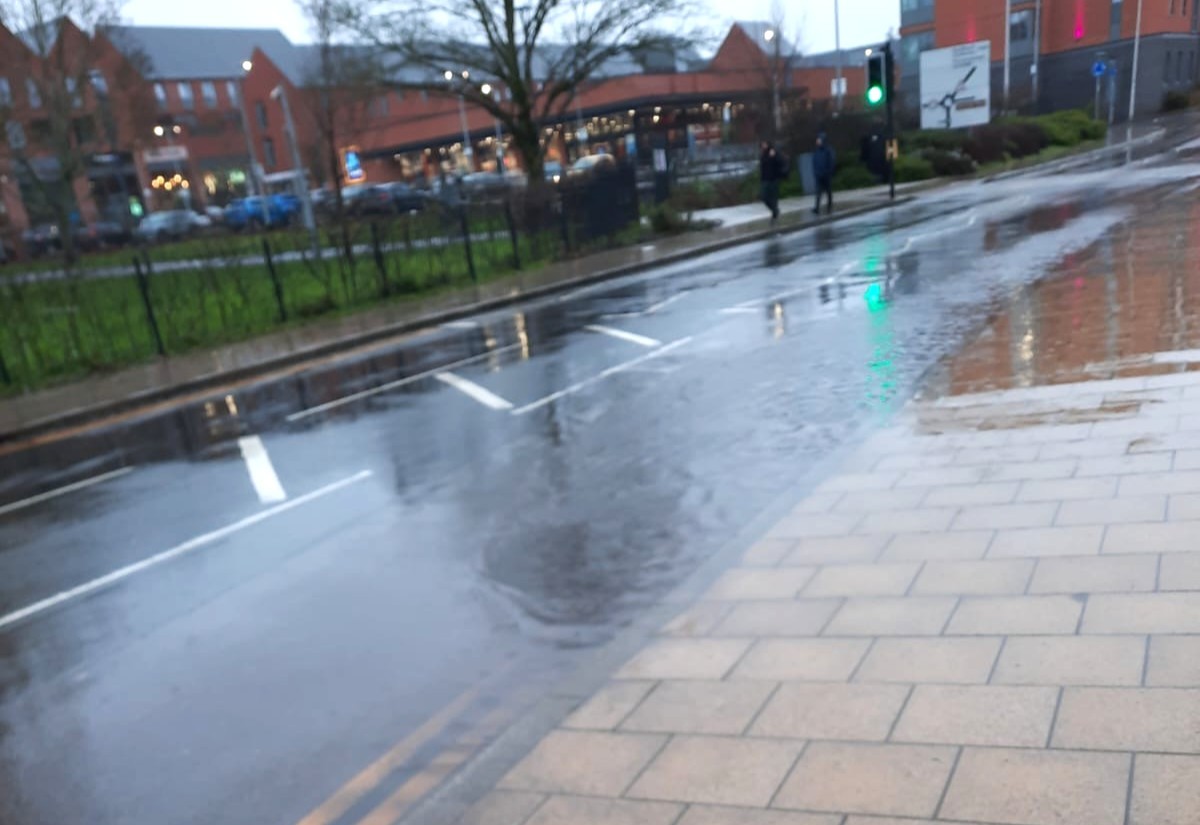
One misstep or splash could ruin your day as enormous puddles, hidden potholes, and speeding cars combine into a wet-weather nightmare following recent heavy rain in the borough.
Perhaps the most dramatic of these can be seen at the Showcase Cinema Roundabout, whenever the River Loddon bursts its banks.
Deep water on the borough’s roads can be dangerous to drivers and cyclists, and problematic for pedestrians when road users pass by at speed.
One Wokingham.Today reader explained how difficult it can be walking to work in wet weather.
She said: “It’s been difficult to avoid getting soaked this week and last.
“I’ve seen several drivers approaching a very big puddle in Wokingham, by the Carnival Pool without slowing down for pedestrians.
“They do behave themselves as soon as I get my phone out, of course, but I saw one chap ahead of me recently who had to leap out of the way to avoid a tsunami.”
The AA advises motorists to approach flood water with caution.
Flowing water and pools higher than four inches (10 cm) deep should be avoided altogether.
If having to cross a large puddle, drivers should let approaching cars pass first before moving slowly and steadily forward, being careful not to create a bow wave over the front of their car.
Revs should be kept higher than usual, and people should try not to stop or stall.
The AA explains that driving fast through wet areas can lead to car damage, and says that it takes just an egg-cup full of water to be sucked into an engine to cause significant damage.
Most engine air intake points are sited low down at the front, so it makes sense to avoid flooding them.
Electric vehicles’ sealed batteries and lack of engine air intake may actually make them slightly better equipped than petrol cars to cope with standing water, but they are not submarines.
EV drivers, like all other motorists, are advised to approach deep puddles with caution, and to cross only if they have no choice.
Significant water depth risks damage to the vehicle’s electrical components and can cause it to float, leading to impaired steering.
After passing through flood water, drivers of all vehicles are advised to test their breaks straight away.
Cyclists face different problems presented by flood water.
Deep puddles can hide hazards such as potholes, glass, and sewage grates.
All of these can damage bike wheels and unseat a rider, with dangerous consequences.
Cyclists are advised not to ride through puddles they can’t see the bottom of.
Instead, their safest option is to check behind them before moving slowly and carefully towards the centre of the lane in order to cycle around standing water (which is usually close to the pavement).
Cyclists with no option but to ride through a large puddle should avoid the kerb edge of it, where there is likely to be more debris.
They are advised to slow down and and to cycle carefully, in a straight line, through the middle of the water, keeping pedalling to maintain momentum, and avoiding sudden sharp turns or breaks.
Pedestrians who risk walking beside flood water may find themselves at the mercy of road users.
But drivers should know that they splash them at their peril.
Road users may be unaware that splashing pedestrians, even by accident, is an offence.
The RAC says that according to section three of the Road Traffic Act 1988, this behaviour is classed as careless driving, and can land the culprit with a fine of up to £5,000, as well as an appearance in court.
Splashing is easily avoided, though, simply by slowing down and driving through standing water carefully in second gear.
For information, visit: rac.co.uk, theaa.com, and for a live map of reported flooding in the borough, people can go to ; wokingham.gov.uk