



































Is it ever OK to read someone’s diary?
And if the person who wrote it knew that you were likely to read it – how certain could you be that the diary would contain their true feelings?
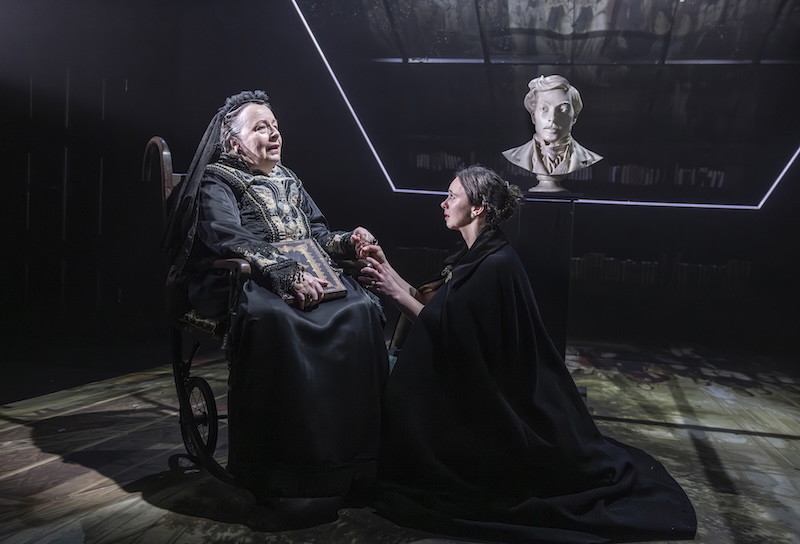
Queen Victoria (Amanda Boxer) is nearing the end of her reign. If she was in any doubt about that, the vultures are circling in the form of son Bertie (Stephen Fewell), itching to inherit the throne after decades of waiting, and daughter Beatrice (Lydia Bakelmun), tiring of being at her mother’s beck and call.

But there is a problem. The Queen has been diligently recording her thoughts in her diaries since her youth. Thoughts that, should those diaries ever be published, may expose her less-than-affectionate views of the future king.
Dismissing Bertie and Beatrice’s offer to “sanitise” her diaries, Victoria is nevertheless motivated to revisit her records of the past, seeking comfort in the memory of her much-missed late husband, Prince Albert (Rowan Polonski). Her much-missed, perfect, beautiful late husband.
Or so her diaries record him…
…but as she journeys back into her past (her younger self played by Jessica Rhodes), she starts to wonder if those records are true.
Netflix’s “The Crown” attracted much attention for shining a revealing light on what goes on behind the closed gates of royal establishments. But while many of its revelations had been widely rumoured in the press for years, questions were nevertheless raised about how much of the show was historical fact vs. fiction.
Daisy Goodwin’s “Victoria: A Queen Unbound” faces a similar challenge. It takes arguably the UK’s most famously perfect couple and deconstructs the relationship, suggesting that his branding as “her husband of 21 years, father of their nine children, private secretary and closest advisor” was a smokescreen she was pressured to inserting into her diaries. In reality, it posits, he was a domineering bully, guilty of coercive control, deploying everything from threats to repeated pregnancies in order to assume more and more of the Queen’s power.

While this may be an unappetising concept to some, there are certainly a few historical incidents (recorded in the programme) which lend weight to Goodwin’s argument. “Thought provoking” is a term often used in reviews, but it arguably fits best when applied to a work that makes you question your basic assumptions and helps you to see a familiar thing in a different light. In this sense the play is a triumph; coercive control has recently been classed as illegal in the UK, yet it remains a poorly understood and often overlooked crime, so the story is also very timely.
It is difficult, however, not to question how historical factual it is. The play depicts a time period where tell-all books by former palace staff were unimaginable, and in the absence of witness statements (or, as the play suggests, reliable first-hand accounts), one cannot help but wonder how much of the dialogue is wholesale invention. This is arguably unimportant – the subject is perhaps coercive control rather than Queen Victorica – but if you’re of a historical or Royalist persuasion then it is worth keeping in mind before you decide to purchase your ticket.
There are also some uncomfortable shifts in tone which threaten to derail the story at times. Albert’s controlling behaviour is (quite rightly) treated seriously and with weight – the way these scenes are delivered make it clear that his actions are wrong. Yet for every instance of his abuse, there are twice or three times as many of Victoria heaping scorn and derision upon her children, and these (perhaps equally abusive) moments are played for laughs. Her son is fat, useless and contemptible, as she tells him on multiple occasions and to much laughter; her daughter is also fat, should never have gotten married, and should’ve stayed at home at the Queen’s beck and call. There is arguably merit in presenting such a nuanced depiction of the Queen, as it questions the (incorrect) belief that if a victim doesn’t behave perfectly at all times then they cannot be a victim – but at the same time, one does experience a sense of emotional whiplash.
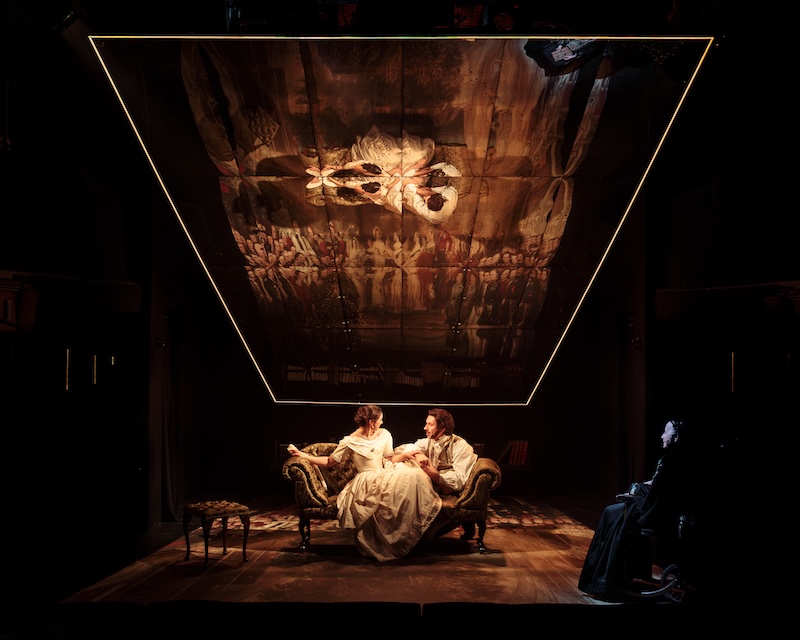
The Watermill Theatre have, however, generated another sparkling gem of a production. The set is an atmospheric masterpiece, suggestive of Victorian grandeur without being overbearing. Boxer is a sterling Victoria, blending her gruff exterior with the fragile vulnerability of someone facing their mortality. Rhodes is a dynamic and multi-faceted younger version of the queen, a defiant spirit trying to balance independence with (possibly misplaced) affections. Polonski rounds out the core trio with a studied and complex Albert, aching to get on with the work he’s passionate about, clearly affectionate towards his children, but – as depicted here – pretty horrendous towards his wife.
So if you enjoyed “The Crown” and aren’t afraid to explore the workings of abusive relationships, this is very powerful and relevant piece of theatre.
“Victoria: A Queen Unbound” runs from the 27th March to 9th May; tickets can be booked at https://www.watermill.org.uk. Photos are courtesy of Pamela Raith.