






































The impact of homelessness in Wokingham Borough has been discussed as the number of households in emergency accommodation has been revealed.
Councils have a duty to provide housing to eligible homeless people who have a priority need and are not intentionally homeless.
Emergency accommodation is a short-term, immediate solution for homelessness, with households being put in hotels and B&Bs until suitable housing can be sought.
The number of people who are homeless in Wokingham Borough was brought up at a meeting of the council’s overview and scrutiny commission meeting on Tuesday, October 21.
Councillor Shahid Younis (Conservative, Bulmershe & Coronation) asked for the figure.
While the direct numbers of individuals who are homeless was not provided, there were available figures for households for Quarter 1 of 2025/26, covering April to June of this year.
The council’s housing team saw 156 households present as homeless or threatened with homelessness.
The team was able to prevent homelessness for 46 households and relieve homelessness for 47 households during this period.
This left eight households in emergency nightly let B&B accommodation in Quarter 1.
Stephen Conway, the leader of the council, explained that the numbers are constantly fluctuating.
Councillor Conway (Liberal Democrats, Twyford, Ruscombe & Hurst) said: “Emergency accommodation is the kind of accommodation that’s the most expensive and unsatisfactory, both to the people who are put in it and to the council.
“I mean, it’s not an ideal situation, but emergency accommodation is the only option when you haven’t got enough temporary accommodation, and temporary accommodation is the only option when you haven’t got enough affordable housing provision generally.
“So this is a big challenge in an area like ours with high housing costs and high private rental costs.
“And it’s one that we are focused on trying to improve the quantity and the quality of the affordable housing we’ve got within the borough.
“That’s vitally important not just for the well-being of the people who are put in this tragic situation and being rendered homeless but also so everyone is able to contribute to society by having a good and safe and secure home.”
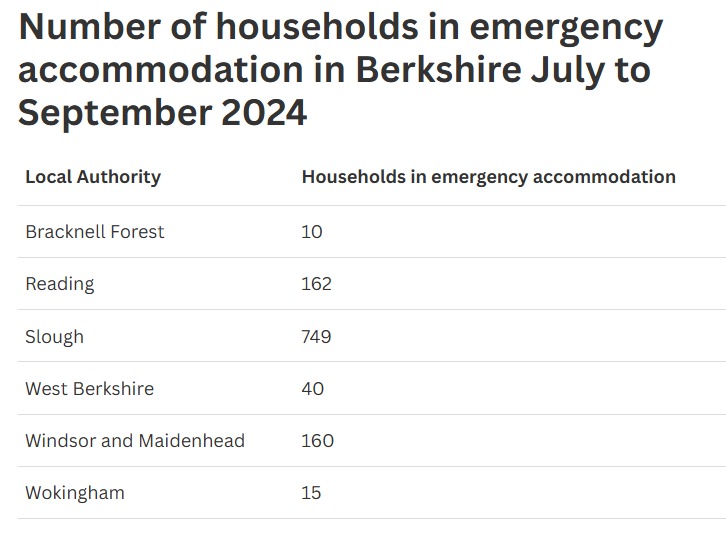
According to government figures from July to September 2024, there were 15 households in emergency accommodation in Wokingham Borough, the second lowest in the county.
Only Bracknell Forest had lower, with 10 households.
Graham Ebers deputy chief executive of the council said: “By way of broader context, and this is by no means intended to either trivialise the impact or indeed the future risk to the council, but I am acutely aware across the country, particularly London but also in parts of Berkshire, where there are three very, very significant financial pressures that they face. One is adult social care, one is children’s services and the other is temporary accommodation. And at the moment we’ve done um well in terms of our interventions and supply.
“I hope I am not tempting fate in any way because, of course, this is a high-risk area and we know that there’s inward migration pressures, population pressure, supply, private sector availability pressures.
“So all of those um means that we have to keep a close watching brief, but financially it is not manifesting into a concern in the way it is in many local authorities. ”