


































Wokingham’s German twin town of Erftstadt hit the headlines worldwide in July, including this very paper.
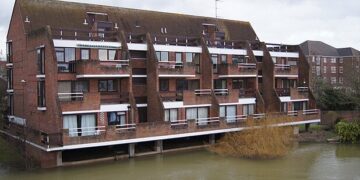
The town was badly affected by the flooding of the River Erft, especially in the district of Blessem, following several days of torrential rain. Even a castle was partially swept away.
There were about 200 deaths in various parts of Germany, with the Netherlands and Belgium also affected.
The flooding was a “catastrophe of historic dimensions” according to Armin Laschet, premier of North Rhine Westphalia – Germany’s largest state, where Erftstadt is situated.
Laschet is the CDU party candidate to replace Chancellor Angela Merkel when she steps down this month.
Climate change experts reckon that these freak weather conditions will become much more common in the years ahead.
London also had flooding problems in July. The city is protected from sea surges by the Thames Barrier, but is vulnerable to flooding from heavy rainfall.
The local authorities and fire brigade in Erftstadt have come in for criticism from the German TV channel WDR and others for their slow response to the flooding threat and in communicating warnings. German weather forecasters had already pinpointed Erftstadt as the centre of the bad weather front and hydrologists had warned of a “once in a century” flood.
Many locals had little or no notice of what was to come and some lost everything.
Even the fire station was flooded, with electricity cut off and sirens silenced.
There were indications from higher up the river that the water levels were rising rapidly, but this was not acted on quickly enough.
The River Erft flows into the River Rhine near Düsseldorf.
I worked in Düsseldorf for nine years and my flat was 200 metres from the Rhine. On the few occasions when the river got very high, it overflowed its banks into an area south of the city designated as a flood plain.
A few roads would be closed and ferries disrupted, but otherwise there were few problems.
There have been many major floods from the Rhine and you can see the levels reached over the centuries by markings on the walls in some pubs and restaurants nearby.
The last major floods around Düsseldorf were in the 1980s.
The Erft was straightened and diverted in the past to make way for open-cast brown coal mining, which has created problems and vulnerabilities. It also does not have adequate flood plains like the Rhine. There is a gravel quarry near the river in Erftstadt which filled up with water and then overflowed, as seen in many dramatic press photos. Concerns about this had been raised before. The protective wall the owners had been compelled to build collapsed under the force of water.
Here in Wokingham we, perhaps fortunately, have no river going through the town centre. The River Loddon is the nearest and flows into the Thames at Wargrave. The typical water flow (discharge) rate of the River Erft is 16.4 cubic metres per second (m³/s), nearly eight times as much as the River Loddon at 2.16 m³/s.
The flow rate of the River Rhine is 2,300 m³/s, over 30 times greater than the Thames at 65.8 m³/s.
The River Loddon floods now and then, especially in Winnersh, Hurst and Woodley, with the Showcase Cinema car park a frequent victim. The Thames also flows through part of Wokingham Borough, with Wargrave suffering flooding in 2014 and Sonning in February this year.
It is good to see that Wokingham Borough Council is taking steps to reduce its carbon footprints and ours to help combat global warming.
Wokingham may not be highly susceptible to the effects of global warming, but, if freak hot weather were to become problematical, we might get forest fires. We can only hope that we are promptly informed of the risks and threats should we suffer extreme weather conditions in future.
And our comrades in Erftstadt, of course.