
















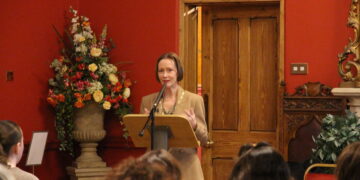














Paul Chapman gave members and guests of The Arts Society Wokingham a fascinating and moving insight into the multilayered symbolism in Picasso’s iconic masterpiece, Guernica.
Picasso was commissioned by the Spanish government to create an artwork to occupy a whole wall of the Spanish Pavilion at the Paris International Expo of 1937. The Spanish Civil War was at its height.
On April 26 1937, the Basque town of Guernica was barbarically bombed by German and Italian forces at the request of the Nationalists led by Franco. Stark black and white press photographs were circulating and these both shocked and inspired Picasso.
He started work immediately on this vast, stylised monochrome painting.
Picasso’s use of abstract symbolism is often complex. The bull on the left symbolises the people of Spain and its tail is the smoke rising from the bombing of Guernica. The mother holding the dead child in her arms represents the suffering of the innocents at the hands of Franco.
Paul explained that the woman being burnt on the extreme right of the painting represents Picasso’s own mother who was trapped in Barcelona. The triangular flames represent his fear for her safety.
The soldier with the severed head at the bottom of the painting is a symbol of the Spanish Republic, trampled by the Nationalists. Paul pointed out an important detail which is often missed. There is a small flower beside the broken sword in the hand of the soldier – a symbol of hope amid the carnage of war.
After the Paris Expo the painting went on tour to Scandinavia then England, and was in France at the start of the Second World War. It was hastily packed onto a refugee ship and sent to safety in America. After the war it went on tour again to Brazil and Europe and then back to America.
Not only is this painting embedded in Spanish culture, its message continues to resonate across the world. During the time of the Vietnam War it was adopted by the anti-war demonstrators as a symbol of their cause
In 1955 Nelson Rockefeller commissioned a tapestry copy of it to be made – see image above. This was loaned to the United Nations in 1985 and placed at the entrance to the Security Council Chamber as a reminder of the importance of peace and security.
This month, the Arts Society Wokingham invites you to come on a tour of Venice.
On Monday, May 15, at 7.30pm at King’s Academy, Binfield, Douglas Skeggs will be giving an illustrated talk on 19th century Venice and the painters, poets and authors who were inspired by this city.
Guests are always welcome but do email memsectheartssocietywham@gmail.com to register beforehand. The talk will also be live-streamed and available to watch from home on the society’s own YouTube channel.
For further details please visit the Society’s website, www.The ArtsSocietyWokingham.org.uk
Sue Bryant