































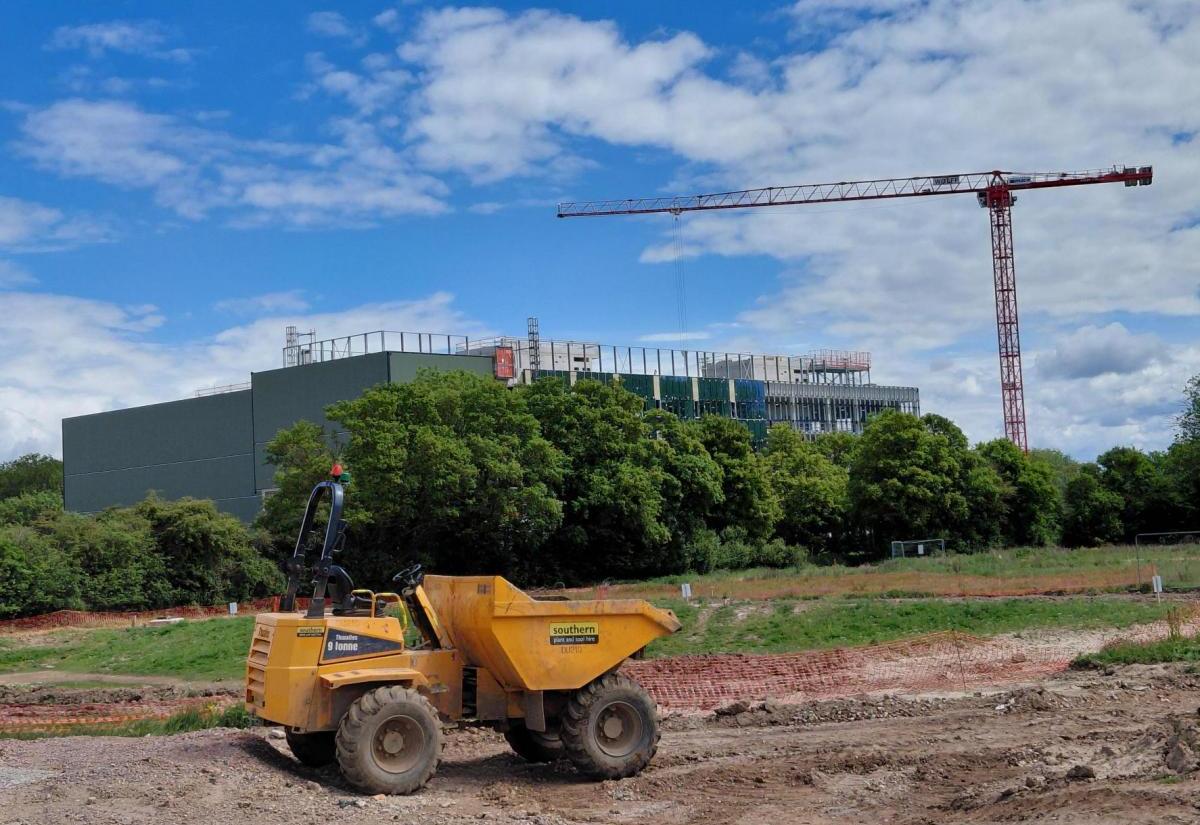
A huge facility is being built near Reading that will be used to hold millions of items once complete.
The massive building is visible when driving along the M4 heading westbound on the approach to Junction 11.
The construction is taking place for the ‘Natural History Museum Unlocked’ facility at Thames Valley Science Park.
It will serve as a state-of-the-art collection, research and digitisation centre for the museum once it is finished.
Work began on the building in September last year.
The museum’s website states: “This new facility will house purpose-built storage for 28 million specimens, around a third of the Museum’s vast collection.
“A major scientific research hub, it will provide innovative digital, analytical, and genomic technologies and facilities for the scientific community.
“The Museum’s collections of mammals, non-insect invertebrates (such as corals, crustaceans, molluscs, and worms), fossilised mammals and invertebrates, molecular collections, and micropalaeontology will be housed at the new centre in bespoke storage.”
The project involves both the construction of the building itself and a new access road for future users to get to it.
The website Construction Map shows that work on the access road began in March last year by Fergal Contracting Co, and is due to be completed on Sunday, July 19.
Meanwhile, the building of the Natural History Museum Unlocked facility, which is being carried out by Mace Construct, will end next year, on Monday, May 31, 2027.
Photos show that parts of the exterior of the building have been finished, with a construction crane being used for the project.
The building will span the equivalent of three football pitches, totalling 25,000m2.
Once the construction is completed, Natural History Museum Unlocked is expected to be operational by 2031.
Its use will clear the way for two galleries, which closed in 1948 and 2004, to be reopened at the Natural History Museum in South Kensington.
Thames Valley Science Park is owned by the University of Reading.
When construction began, Professor Robert van de Noort, the vice-chancellor of the university, said: “This collaboration with the Natural History Museum perfectly aligns with our commitment to world-leading environmental research and innovation.
“By developing this state-of-the-art facility at Thames Valley Science Park, we’re creating unprecedented opportunities for collaborative research that will help address the planet’s most pressing challenges. We’re excited to see this transformative project moving forward.”
The project is taking place after it received approval from Wokingham Borough Council’s planning committee on March 13, 2024.
It is not to be confused with the British Museum Archaeological Research Collection, which opened in June that year.
The British Museum facility holds 1.3 million objects, which were relocated following the government’s decision to sell Blythe House in West Kensington in 2015.