





























![Reading Festival has laid out its Look Out For The Planet pledge ahead of its return next week, bringing measures set to promote sustainability. Picture: Luke Dyson [LukeDyson.com]](https://wokingham.today/wp-content/uploads/2026/08/Img1871502-360x180.jpg)




Fears about increasing temperatures and the threat AI poses to jobs were raised at a public exhibition for a planned data centre near Reading.
The current Microsoft offices at Thames Valley Park in Earley could be replaced by a data centre.
The project involves the demolition of three office buildings to make way for a data facility made up of an office, generators, fuel cells and a substation.
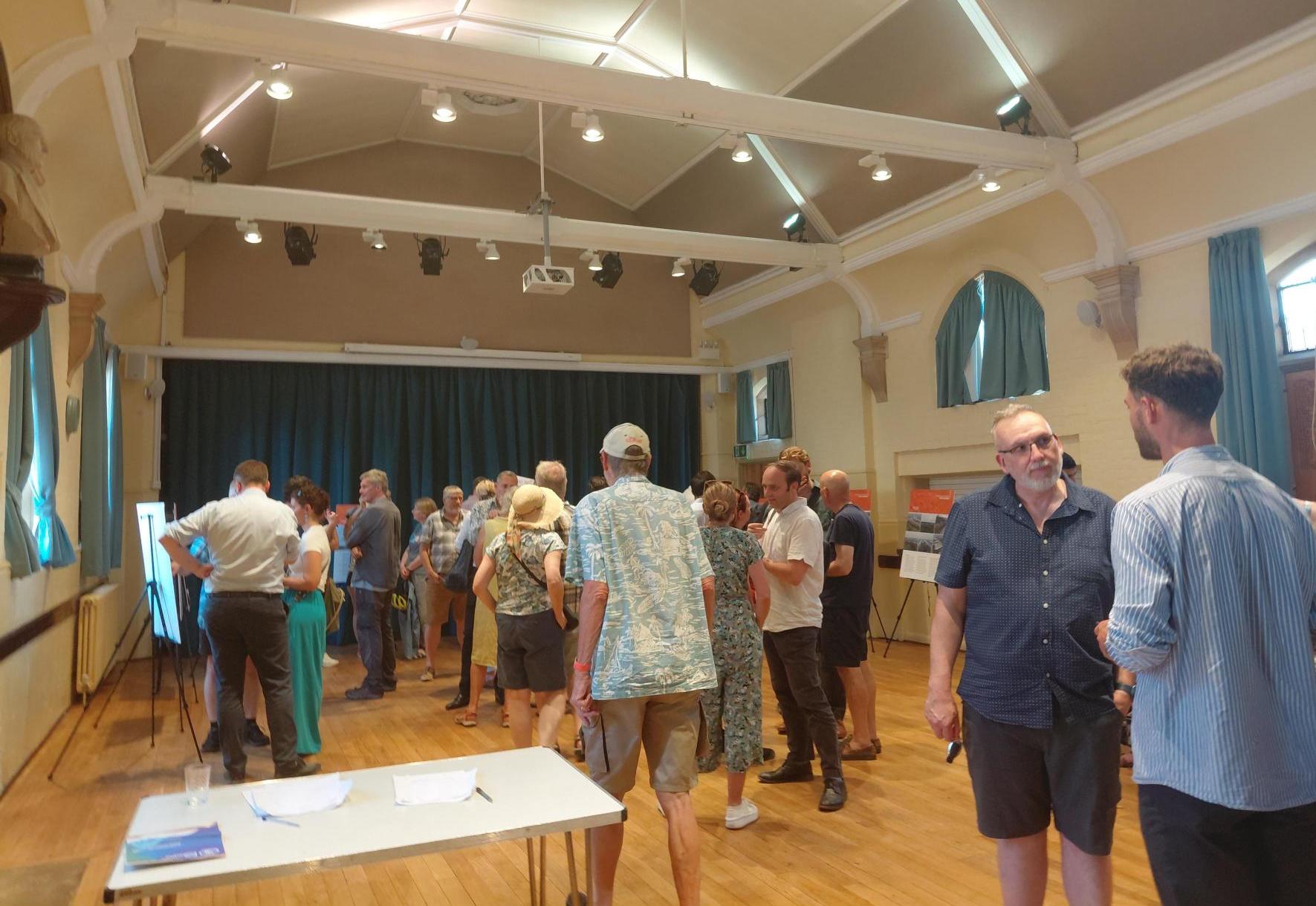
Early-stage plans were on display at a public exhibition at Pearson Hall in Sonning on Tuesday, July 7.
Dozens of people attended the exhibition, with interest from politicians and protesters who held notes stating “be louder Microsoft can’t hear” and “data centres like this have devastating health and environmental impacts.”
While Microsoft is a tenant of three buildings, it was made absolutely clear that the project is being undertaken entirely by the landowner, FH Trustees, rather than Microsoft itself.
It is unclear whether the facility will be used for data storage or to increase artificial intelligence (AI) capacity.
Micah Campbell-Webb, one of the protesters, said: “It’s so open-ended and nobody has any idea what’s going on, it poses the environmental risk of also facilitating AI, as well as the intellectual risk of people becoming dependent on AI permanently, which is something that especially school students at the minute are currently facing.
“The workplace is also filled with AI, which is causing a bunch of redundancies.
“They say we’ll open it up for 115 workers permanently; we’re saying, well, 115 isn’t enough, because the things that data centres are doing are causing so many redundancies, and harming employment when it’s already an employment crisis in the UK, that it’s just so detrimental to society as well as the environment as a whole.”
Major fears have been raised about data centres creating heat islands, with a report in The Guardian citing research from Cambridge University that data centres can increase heat in the vicinity by between 2-9C.
Varinder Anand, the BAME officer of Earley and Woodley Labour, intimated that his concerns about heat and sound generation had been eased.
He said: “It’s pretty comforting the way they are going to take care of the environmental challenges, and they said the generator will be only for backup, so otherwise they are going to use the biofuel, so that was a sort of a relief.
“Because if it was a continuous use of generators, then it causes sort of noise pollution.”
Mr Anand worked for British Gas at Thames Valley Park for 15 years.
His primary concern about the noise would be the impact that it has on birds and wildlife surrounding the park.
Shubhendu Das, who owns a property with trees south of the railway line, said: “The forest is a nice place, I hear the birds singing in the morning and evenings, and I like to go there to relax.
“I cannot basically do anything in that forest because it’s protected by the council.”
Mr Dudas complained about the double standard between the protections imposed on the forest that limit what he can do on his property as a private individual, and the major impact the data centre could have.
He said: “You can’t have one set of rules for one people and another set of rules just on the opposite side of the railway.”
Roux Davies, an accountant, expressed concern about how the electricity use of the data centre will impact neighbouring Reading Borough Council’s goals of creating energy-efficient homes.
He said: “Reading council has a housebuilding target of 800 homes a year, included in that are energy-efficient green homes and affordable council homes.
“In 2023, they had issues building 50 affordable homes because of the lack of capacity on the electricity grid.
“Because they couldn’t have the capacity on the grid to have green infrastructure like heat pumps, they instead installed gas heating.
“The data centre is going to put such a strain on the grid, even over a decade, that it is going to take away from the council’s ability to build those green homes because it’s going to lead to further delays in infrastructure improvements on the grid and to having more homes.”
Mr Davies was referring to 50 affordable homes within the Emmer Green Drive development, which will not have heat pumps due to the lack of grid capacity.
The consultation received interest from the Green Party, with Reading borough councillors Doug Cresswell and Kaisa Nikulina (both Green, Katesgrove) in attendance, as well as party member Gary Shacklady.
Cllr Cresswell said: “I’m not convinced that Wokingham needs a large additional source of heat, I think summer days like this will feel a lot hotter for people in the local area if the data centre gets ahead.”
His daughter Pip added: “We’ve just had the hottest May in recorded history.
The temperatures we’ve been having were predicted for 2050, so we’re reaching high temperatures much faster because of proposals like this.”
Mr Shacklady said: “I’m definitely lacking the confidence that this would be a good thing. It seems like an awful idea, very poorly executed to this point at least.
“I appreciate that there is demand for national government to make these things happen, and that they’re prioritising a move towards AI and to more data centres for storage as well, because that’s the way we’re going. cloud-based and bringing in tech, and we’ve always been an area that is high on that agenda and well employed in this area, and that’s great, but I don’t see this particular building being a positive one for our area.”
Meanwhile, Leon Cook (Conservative, Thames), who was elected to Wokingham Borough Council in May, said: “Thames Valley Park was very full at one time and has not been in recent years, unfortunately.
“This meets the definition of the local plan in terms of being a greyfield development.
“However, there’s a lot of interest in this. The minute this consultation day was advertised, there were quite a few stories effectively about either water cooling or the biological impact of the data centre would be.
“Within planning guidance, I would say Thames Valley Park is probably an ideal site for it, but whether it comes to access, transport, grid access, water cooling, there will be quite a number of comments submitted by constituents with concerns about mitigating all of that.”