









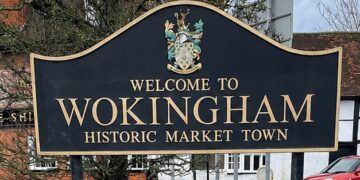






We walk past its historic timber-framed buildings every day, grab our morning coffees in the town centre, and relax in its award-winning green spaces.
But beneath the surface of our modern, bustling market town lies a history filled with royal secrets, eccentric residents, and a surprising connection to global pop culture.
Whether you are a lifelong resident or a newcomer to the borough, here are some fascinating facts that make Wokingham truly unique.
The ‘Molly Millar’ lane legend
If you live in Wokingham, you have almost certainly driven down Molly Millars Lane or stopped for a drink at the pub named after her. But who was the real Molly Millar?
Local folklore tells us that Molly Millar was Wokingham’s very own eccentric resident during the 17th or 18th century. Depending on which local historian you ask, she was either a fiercely independent old woman who lived in an isolated cottage along the trackway, or the town’s resident “witch” who survived by charging travellers a toll to pass safely through the dense woodland. When the town expanded into an industrial area, the road was officially named in her memory.
It was a stronghold for the notorious ‘Wokingham Blacks’
During the 1720s, the area surrounding Wokingham was terrorised by a notorious group of outlaws known as the “Wokingham Blacks.”
Far from being a simple gang of thieves, they were an organized group of poachers and protesters who operated within Windsor Forest. They earned their name by blackening their faces with soot to disguise themselves at night. They fought fiercely against the harsh forest laws introduced by King George I, which restricted local peasants from hunting deer or gathering wood.
The group became so disruptive that Parliament had to pass the “Black Act” of 1723, introducing the death penalty for anyone found disguised in the royal forests.
The Tudor epicenter of luxury silk stockings
Long before it became a modern commuter town, Tudor Wokingham was at the absolute height of high fashion. In the late 16th century, Flemish weavers fleeing religious persecution settled in the town and established a booming silk industry.
Wokingham became nationally famous for its hand-knitted silk stockings. In fact, the trade was so vital to the local economy that in 1625, an official town order was decreed: anyone living in Wokingham who did not have a registered trade was legally required to work in the silk knitting industry. Evidence of this cottage industry can still be seen in the historic timbered houses lining Rose Street.
Our churches ring with 14th-century Wokingham bells
If you listen to church bells ringing out across the South of England, there is a very good chance they were born right here in the borough. From the 14th to the 16th centuries, Wokingham was famous for its bell foundry, operated most notably by the local Lush brothers.
Operating out of what is now Bell Foundry Lane, the foundry cast massive, high-quality church bells that were transported across Berkshire, Hampshire, and beyond. Many of those medieval bells are still hanging in local church towers today, ringing out across the countryside just as they did 600 years ago.
The town was brutally burned during the Civil War
Wokingham found itself caught right in the crosshairs of the English Civil War between 1643 and 1644, acting as a regular raiding ground for both the Royalist Cavaliers and the Parliamentarian Roundheads.
The town’s history took a dark turn when a group of King Charles’ soldiers, who were being besieged in nearby Reading, marched into Wokingham demanding bedding and firewood. The fiercely independent townspeople told the soldiers to clear off.
Outraged, the soldiers retaliated by burning down over 30 buildings — completely destroying nearly 20% of the town and crippling the local economy for decades.
A rainy day at a Wokingham inn inspired a famous poem
Our town once played host to a literary super-group. During the Georgian era, legendary writers and poets Alexander Pope, Jonathan Swift, John Gay, and John Arbuthnot found themselves stranded at Wokingham’s historic Rose Inn (now the site of the Rose Street shops) while sheltering from a heavy rainstorm.
To pass the time, the brilliant minds collectively penned the famous romantic ballad Fair Molly Mogg, dedicated to the extraordinarily beautiful daughter of the innkeeper. The poem became a national sensation in the 1700s, putting the Rose Inn and Wokingham firmly on the literary map.
Schooling ground for a future King and Netflix stars
Prince William, the Prince of Wales, spent his formative educational years right here in the borough, attending Ludgrove School as a boarding student between 1990 and 1995. More recently, Wokingham’s secondary schools have proved to be a breeding ground for Hollywood talent; The Crown breakout star Meg Bellamy was discovered right out of St Crispin’s School on London Road, while A-list actor Nicholas Hoult (Skins, X-Men, Mad Max) grew up locally and attended The Emmbrook School.