
















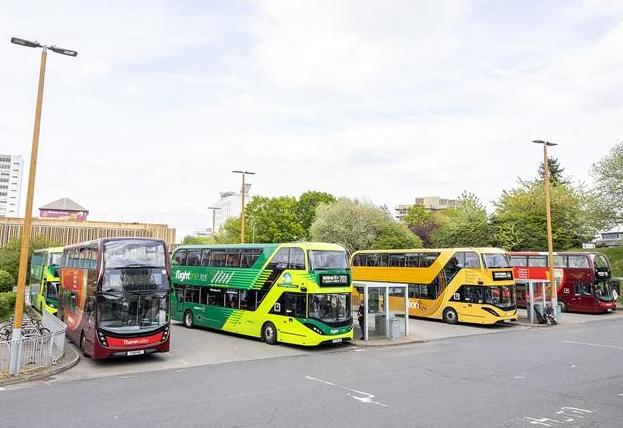
Funding for three bus services is set to be withdrawn following a public consultation run by Bracknell Forest council.
Data showed the 299, 598 and 151/151A services are very poorly used, making them financially and environmentally unsustainable and poor value for money for taxpayers.
The difficult decision to stop the services was agreed at the meeting of full council during February.
The 299 bus route, serving parts of Winkfield and Warfield to the north of the town centre, will operate for the last time on Wednesday, April 15.
The 598 route, running from Crowthorne rail station to Camberley, through Little Sandhurst, will operate for the last time on Tuesday. April 14.
The 151/151A route, connecting Bracknell and Wokingham through Binfield, will stop operating at the end of July.
Councillor Guy Gilbe, cabinet member for planning, transport and countryside, said: “I know the loss of these services will be a blow to the people who use them, but the affected services are generally not well used compared to other routes.
“Buses frequently run empty and some trips cost the council up to £16 per person each way.
“We investigated all possible means of alternative funding but it was not possible to save the services.
“There are much more cost-effective ways of providing essential transport to people, which do not see the taxpayer pay over the odds.
“We are now looking at alternative provision for people who use these routes, like community or voluntary transport schemes, which will be better value for money and better for the environment.
“It is true that some users of these bus services felt strongly that they should continue. Against this, more than half of the respondents to the budget consultation agreed that we should stop providing non-statutory services, including bus routes.”
For elderly and disabled users of these services, there are alternatives such as voluntary car schemes and community transport provided by organisations like Keep Mobile.
For a range of health, cost and environmental benefits, the council promotes and provides infrastructure for active travel modes for those who can walk or cycle.